
Going for Growth: A Guide for Economic Development Leaders
Key Takeaways
The Second-Stage Blind Spot: Mid-sized local firms drive sustained jobs, yet policies often overly focus on external corporations or startups.
Small Business Realities: Most small enterprises are lifestyle ventures; economic strategies must target the rare subset of scalable companies.
The Power of "Gazelles": A tiny fraction of mature, innovative firms generate most net new jobs and productivity gains.
Economic Gardening: Targeted strategies - like market intelligence, independent programs, out-of-region trade, and executive talent bridging - maximise regional returns.
When local governments seek to boost their economies, the traditional playbook often points toward attracting major corporations from outside the region. Alongside this, supporting startups has become a popular strategy, promoted for its potential to foster innovation, birth entirely new industries, and capture headlines with the promise of future jobs.
While both inward investment and startup support have a place in the policy mix, this dual focus often leaves a major blind spot. Research data consistently shows that ‘second-stage’ businesses - established, growth-oriented, mid-sized local firms - are actually the primary engines of sustained employment and productivity growth in a community, yet they are frequently not given sufficient attention..
By shifting our strategic focus toward identifying and nurturing the existing businesses already rooted in our communities, we can unlock a far more reliable and fertile pathway to long-term economic resilience and growth.
The Business Pyramid
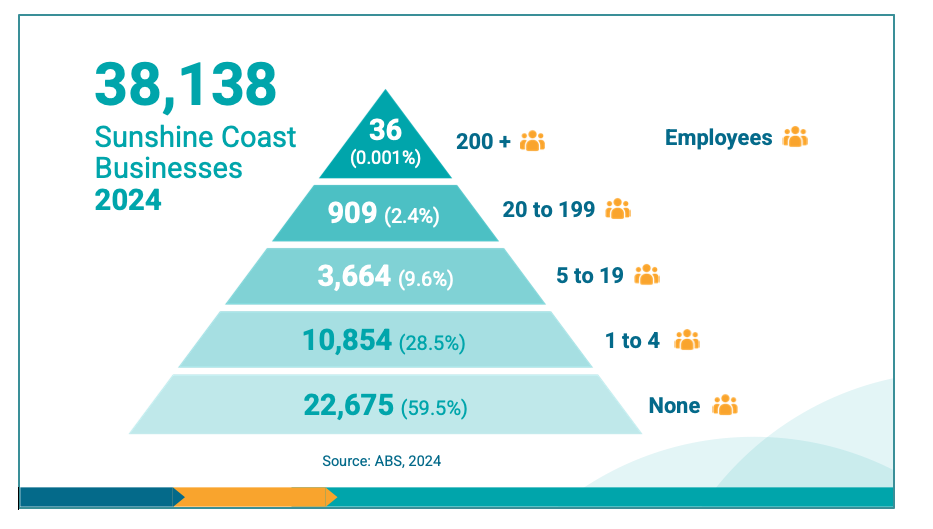
Business Pyramid, Sunshine Coast, Qld, Australia
As an example, the Business Pyramid above illustrates that there are 38,138 registered businesses on the Sunshine Coast. The vast majority are small-scale enterprises, with almost 60% classified as ‘non-employing’ (where the business owner operates alone without staff).
A further 28.5% are micro-businesses employing between one and four people. This means approximately 88% of all regional businesses (33,529 enterprises) operate with four or fewer employees.
This business size hierarchy is a common structural pattern and is by no means unique to the Sunshine Coast. Across Australia, 88.5% of businesses employ fewer than four people, while in the UK, 95% have nine or fewer.
‘Most small business owners are neither inspired, nor driven, to build large empires.’ Infusionsoft Australia
Research consistently shows that most small business owners do not have strong ambitions for large-scale growth. Instead, many are content with operating lifestyle businesses, which provide a decent living and the flexibility of being their own boss.
A study of 400 U.S. small business owners found that 88% were not driven to build large companies, with only 12% reporting a strong desire for growth. This is reinforced by broader research indicating that most small business owners do not expect or even want to grow or innovate.
Based on international research, it is reasonable to assume that most small businesses on the Sunshine Coast - and in most places - are not seeking major expansion.
Ultimately, the critical question for regional economic strategy is not whether this distribution is normal, but rather: which specific businesses and owners possess both the capacity and the motivation to scale up and create new employment opportunities?
The Power of the ‘Gazelles’
While startups often capture the public's imagination, they face high exit rates; roughly half fail within their first few years, neutralizing much of their initial job creation. True, sustained employment growth is driven by a very small, highly dynamic cohort of established firms often referred to as "Gazelles."
The 6% Rule: A landmark UK study, The Vital 6 Per Cent, revealed that a mere 6% of high-growth, established businesses were responsible for over half of all new net jobs created by existing businesses.
The Innovation Advantage: These high-performing companies span the entire economy and are not limited to the tech sector. However, their defining trait is innovation; innovative firms grow twice as fast in both employment and sales compared to non-innovative peers. Furthermore, 70% of these high-growth firms are mature businesses (at least five years old) that have successfully transitioned past the volatile startup phase.
Productivity Powerhouses: Recent McKinsey research reinforces this concentration of impact, showing that just 2% of standout firms contribute to 63% of a nation’s productivity.
Putting the Strategy into Practice: Economic Gardening
Rather than focusing on ‘economic hunting’ for external corporate relocations, Economic Gardening is an entrepreneurial development strategy pioneered in Littleton, Colorado, in the late 1980s that focuses on growing local economies from the inside out by providing high-growth, second-stage companies with sophisticated market research and competitive intelligence tools usually only accessible to large corporations.
The focus on second stage growth companies has also been pioneered initiatives globally such as Profitnet in Brighton, The Exchange by Entrepreneurial Scotland, and the Edward Lowe Foundation and Grow Florida and these progams have yielded impressive returns.
For instance, the Grow Florida initiative has directly created over 4,000 jobs and boosted state GDP by $942 million, with participating companies growing 11% faster than their market peers.
Strategic Recommendations for Local Economies
To effectively harness this growth locally, economic development strategies should pivot toward the following targeted interventions:
1. Target Second-Stage Businesses
Shift regional focus to established firms employing between 10 and 99 staff. Rather than attempting to support all of them at once, begin by identifying a pilot cohort of growth-oriented, "coachable" entrepreneurs who are highly receptive to peer-to-peer learning and strategic mentoring.
2. Establish Independent Program Delivery
To ensure maximum engagement and commercial credibility, programs should be run by an entrepreneurial business unit operating at arm's length from government. This unit should tap directly into successful local entrepreneurs and private sector advisors to help deliver the program, most regions have ‘hidden talents’ - successful entrepreneurs with global business experience happy to share if there is a professional and well run program.
3. Focus on High Potential Startups
While startups are vital, not all possess growth ambitions. Rather than measuring success by the volume of new registrations, economic development should focus intensive support on a curated cohort of high-potential startups developing innovative, globally scalable products.
A critical metric for tracking progress is monitoring how many startups actively scale through key annual revenue brackets - such as $1M–$2M, $2M–$5M, $5M–$10M, and beyond $10M. Without tracking these tangible growth milestones, policymakers risk relying on vanity metrics that mask a lack of true economic impact.
4. Encourage Out-of-Region Trade
Prioritise support for businesses that actively export goods or services outside the immediate region. In regions like the US, exporting businesses pay wages that are, on average, 66% higher than those focused solely on domestic, localised trade.
5. Bridge the Executive Talent Gap
Establish active pathways to connect highly skilled, professional remote workers moving into the region with local, expanding businesses. This helps growing mid-sized firms quickly fill critical gaps in leadership and strategic management talent.
Colin Graham, is the founder of Causeway Innovation and has coached 300+ startups and innovative SMEs and 12 regions in Australia and the UK.